How Green Screen Compositing Works: A Complete Guide to the VFX Process Behind Modern Films
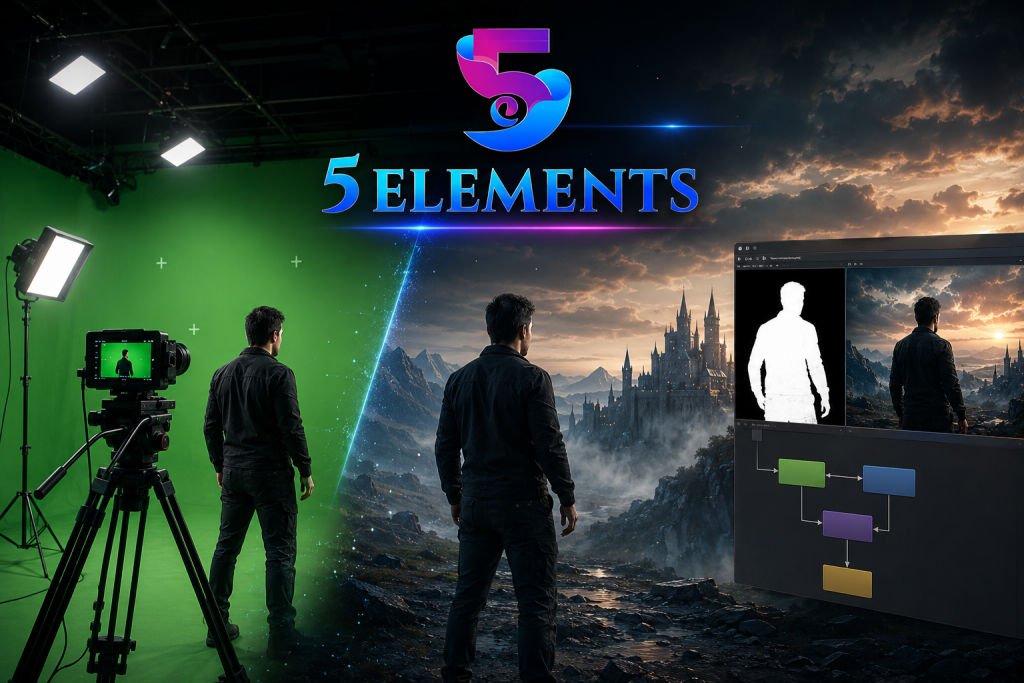
Walk onto almost any professional film or television set today, and you’ll likely spot a wall of vivid green fabric or paint standing in for a location that doesn’t exist yet. That vibrant backdrop is the starting point of one of the most widely used techniques in modern visual effects: green screen compositing. From superhero blockbusters to weather broadcasts, this process quietly shapes a huge share of the visual content we consume every day.
At 5 Elements Entertainment, a Chennai-based VFX studio trusted by major international production houses, green screen compositing is part of our daily craft. In this article, we break down exactly how the process works, why it matters, and what separates a clean, believable composite from one that looks obviously fake.
What Is Green Screen Compositing?
Green screen compositing, also called chroma key compositing, is the technique of filming a subject in front of a solid-colored backdrop — usually green, sometimes blue — and then digitally replacing that background with different footage, an animated environment, or a completely computer-generated scene. The result lets filmmakers place actors anywhere: a spaceship cockpit, a war-torn city, a fantasy forest, or a news studio, without ever physically building or visiting those locations.
The technique isn’t new. Film studios have used variations of it since the early twentieth century, but digital tools have transformed it from a painstaking optical process into a precise, repeatable digital workflow.
Why Green (and Sometimes Blue)?
Green is chosen for a simple technical reason: human skin tones contain very little green, which makes it easier for software to isolate the background color without cutting into the subject. Green screens also tend to reflect more light, which helps cameras capture a cleaner, brighter key. Blue screens are still used in some situations — particularly when a subject is wearing green clothing or when filming underwater or in cooler lighting environments where blue provides better separation.
The Step-by-Step Compositing Process
1. Pre-Production Planning
Good compositing starts long before anyone touches software. VFX supervisors work with directors and cinematographers to plan camera angles, lighting direction, and the eventual background plate. Decisions made here — like matching the lighting on set to the lighting of the intended digital background — save enormous time later.
2. Lighting the Screen Evenly
An evenly lit backdrop is essential. Shadows, wrinkles, or hot spots on the screen create patches of inconsistent color that are far harder to key out cleanly. Professional setups use soft, diffused lighting spread across the entire screen, separate from the lighting used on the actor or subject.
3. Filming the Subject
The subject is filmed with enough distance from the green screen to avoid “green spill” — the reflection of green light onto edges, hair, and reflective surfaces. Camera settings, frame rate, and resolution are matched to the final deliverable format to avoid quality mismatches during post-production.
4. Keying: Removing the Background
This is the heart of the process. Using compositing software such as Nuke, After Effects, or Fusion, artists apply a “keyer” that isolates and removes pixels of the chosen green (or blue) value, leaving the subject on a transparent background. A clean key depends heavily on how well the screen was lit and how much color separation existed between the subject and the backdrop during filming.
5. Spill Suppression and Edge Refinement
Even a well-lit shoot usually leaves some green spill on edges, especially around hair, glass, or shiny fabric. Compositing artists manually correct this spill, refine edge detail strand by strand where needed, and rebuild natural-looking transitions between the subject and the new background.
6. Rotoscoping and Garbage Matting
In areas where automatic keying isn’t reliable — overlapping objects, motion blur, or complex hair movement — artists use rotoscoping to manually trace and separate the subject frame by frame. A “garbage matte” is also applied to quickly remove obviously unwanted areas of the frame before fine keying begins, speeding up the process significantly.
7. Compositing the New Background
Once the subject is fully isolated, it’s layered onto the new background plate — whether that’s a filmed location, a matte painting, or a fully CG environment. This is where the shot starts to feel real.
8. Color Matching and Grading
Perhaps the most underrated step: matching color temperature, contrast, shadow direction, and grain between the subject and the new background. Even a technically perfect key looks fake if the lighting mismatch is obvious. Skilled compositors adjust color balance, add subtle light wraps, and match noise levels so the subject feels physically present in the new environment.
9. Final Detailing
Motion blur, camera shake, depth of field, and atmospheric effects like haze or dust are added last to unify the shot. These small touches are what separate amateur composites from work that belongs on the big screen.
Common Challenges in Green Screen Compositing
- Uneven lighting on the screen, causing patchy keys
- Green spill on hair, skin, and reflective clothing
- Motion blur that makes edge detection difficult
- Fine detail like hair, smoke, or fabric that requires manual rotoscoping
- Reflections picking up green tones on glass, metal, or water
Overcoming these challenges consistently is exactly why studios outsource compositing work to experienced VFX teams rather than handling it in-house with limited resources.
Why Professional Compositing Matters
Poor compositing is one of the fastest ways to break audience immersion. A slightly wrong edge, mismatched lighting, or visible green fringe pulls viewers out of the story instantly. On the other hand, expertly done compositing is invisible — audiences never question whether a scene was filmed on location or built in post-production.
This is why production studios across the US, UK, and Europe increasingly partner with specialized VFX studios in India for compositing, rotoscoping, and paint and prep work. Skilled labor, faster turnaround, and cost efficiency make outsourcing an attractive option without compromising quality — provided the studio has the right pipeline and experience.
How 5 Elements Entertainment Approaches Compositing
At 5 Elements Entertainment, our compositing artists work as an extension of our clients’ production pipelines, handling everything from basic keying to complex, detail-heavy composites for feature films, episodic content, and commercials. Our TPN Gold Shield Certification reflects the security and process discipline that major studios like Disney, Marvel, Warner Bros., Netflix, and Amazon require from their VFX partners.
Whether it’s cleaning up a tricky green spill on flyaway hair, matching color grades across dozens of shots, or rotoscoping a fast-moving subject frame by frame, our team combines technical precision with an eye for what actually reads as believable on screen.
Final Thoughts
Green screen compositing looks simple from the outside — swap one background for another — but the craft behind a convincing composite involves careful planning, technical skill, and countless small corrections that most viewers will never consciously notice. That invisibility is the entire point.
If your production needs reliable, high-quality compositing support, 5 Elements Entertainment offers experienced VFX teams ready to handle projects of any scale, from single scenes to full episodic seasons.