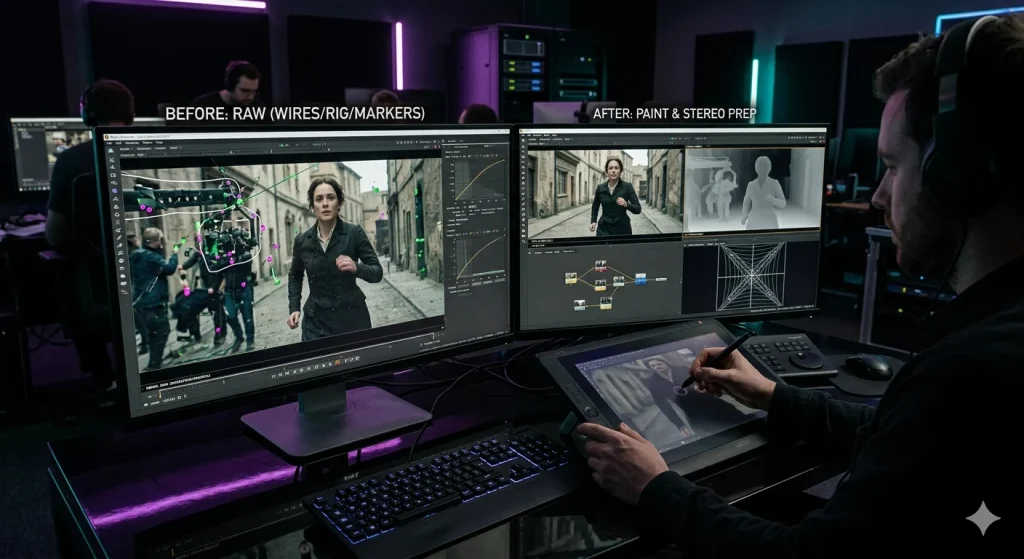
Picture a stunt coordinator watching playback after a rooftop jump. The safety line that kept the performer alive is right there in the footage, cutting straight across the shot. Nobody panics. Everyone already knows that cable won’t exist by the time the film reaches theaters. Somewhere down the pipeline, an artist is going to sit with that footage for hours and erase it, frame after frame, until the jump looks like it happened with nothing holding anyone up at all.
That job — the quiet subtraction and reconstruction that happens before compositing, before CGI, before color grading — goes by a specific name inside production houses: paint and prep. Here’s an honest look at what the role covers, why it demands far more precision than it gets credit for, and how it fits alongside rotoscoping and compositing in a working pipeline.
Splitting the Term Into Its Actual Parts
Studios say “paint and prep” as one phrase, but the two halves ask for different skills entirely.
Paint work is about deletion. A rig shows up in frame. A crew member’s shadow crosses the set. A prop sits three inches from where it sat in the last take. Someone has to remove each of these and rebuild whatever the object was blocking — not roughly, but pixel-accurate, so the reconstructed area survives close inspection on a cinema screen.
Prep work is about handoff readiness. Long before a compositor drops a creature into a scene, or a shot goes through a 3D pass, or a background gets extended digitally, somebody needs to deliver a version of that footage that’s stabilized, correctly separated into layers, and stripped of anything that would slow the next artist down. That delivered footage is the prep.
One side subtracts a problem. The other side builds a usable starting point. Both finish their work before any CGI element enters the frame.
Why This Isn’t Comparable to Editing a Photo
There’s a common assumption that this is just Photoshop stretched across a timeline. Anyone who’s tried it for more than a day knows that assumption doesn’t survive contact with actual footage.
A fix that looks seamless on a single frame can wobble or smear the second the camera starts moving, because the same correction has to stay locked in place across every one of the following frames, not just the one you’re staring at. Film grain, shifting light, and texture all need matching treatment, because audiences pick up on a flawed patch instinctively, long before they could explain what looks wrong. Almost every paint task also depends on a solid camera track being done first — get that track wrong, and the correction work downstream balloons in hours. Stereoscopic and 3D-conversion shots push the difficulty further still, since the identical correction needs to happen twice, once per eye, without the depth ever drifting out of alignment between them.
Given the stakes, it makes sense that studios hand this work to specialists rather than treating it as a task anyone on the team can pick up.
Situations Where This Work Quietly Saves a Shot
This kind of correction shows up constantly, even in movies and shows that read as completely effects-free.
Stunt-heavy scenes depend on it to remove rigging, harnesses, and support pads so the action reads as unaided. Historical dramas rely on it to strip out anything that doesn’t belong in the era — a streetlight, a parked car, signage that’s decades too modern. Long-running television series use it to quietly fix continuity mistakes between takes instead of paying for a reshoot. Restoration and de-aging projects treat a careful paint pass as the foundation everything else gets layered onto. And any shot bound for heavy CGI or a digital set extension starts as a plate someone has already scrubbed down to nothing extra.
Where Rotoscoping and Compositing Fit Around It
These three terms get used almost interchangeably by people outside the industry, so it helps to separate them clearly.
Rotoscoping traces and isolates a specific subject or object, frame by frame, so it can be worked with on its own. Paint and prep instead deals with the plate as a whole — removing what shouldn’t stay and stabilizing what should. Compositing happens last, combining the cleaned plate, any rotoscoped elements, and CGI into the single image an audience eventually sees.
Each stage leans entirely on the one before it. A composite can only look as convincing as the plate underneath it — and that plate’s condition comes directly from whoever handled the paint and prep pass.
The Case for Sending This Work to an Outside Studio
A single difficult shot can eat up hours of concentrated, frame-by-frame attention, which is exactly why many productions now route this stage to an external partner rather than staffing an internal team for the length of one project.
A few practical reasons keep coming up. Outside teams scale with shot count, which matters enormously for episodic productions carrying hundreds of shots against a fixed air date. Studios that specialize in this work run leaner than building an internal department from zero, and they typically already operate inside familiar pipelines — Nuke, Silhouette, Mocha — so there’s no setup delay on either end. Productions based in North America or Europe often find that a partner working from India turns the time difference into an asset, since an overnight paint pass comes back finished and ready by the next working day.
None of that trades away quality. A team running this work at volume, shot after shot, tends to catch problems that someone doing it occasionally would likely miss.
Why the Invisible Part Still Matters
Paint and prep will never get a mention in a trailer or a line on a poster. Its whole purpose is to disappear so thoroughly that its absence just reads as fact — the cable was never there, the modern rooftop antenna never made it into frame, the continuity slip simply didn’t happen. Every convincing shot in modern film and television owes something to this stage, whether or not anyone watching ever learns what to call it.
Frequently Asked Questions
What makes VFX paint different from standard photo editing?
Photo editing only has to convince the eye in one still frame. VFX paint has to hold that same illusion across every frame of a moving shot while tracking camera motion, grain, and shifting light continuously, which is a considerably harder technical problem than fixing a single image.
How much time does a paint and prep pass usually take?
It depends entirely on the shot. A simple object removal might take an hour or two, while a full clean-plate build for a stereoscopic conversion can stretch across several days for one shot alone.
Can this correct continuity mistakes after a shoot has already wrapped?
In most cases, yes. Misplaced props, wardrobe inconsistencies, and background mismatches between takes can typically be fixed digitally, which often spares a production the cost and schedule hit of a reshoot.
Is this only used on large theatrical productions?
No. Streaming shows, television series, commercials, and independent films all rely on paint and prep regularly. It’s one of the most consistently used VFX services across every budget level, not something reserved for big-budget releases.
Do the same people usually handle both rotoscoping and paint and prep?
Some artists work across both, since the two disciplines frequently overlap on a single shot. Most studios still treat them as separate specialties, though, staffing dedicated people for each rather than relying on one artist to consistently cover both.
Ready to Outsource Your Paint & Prep Work?
Whether you’re producing a feature film, OTT series, commercial, or animation project, 5Elements Entertainment delivers high-quality VFX Paint & Prep, wire removal, object cleanup, clean plate creation, and shot preparation services with precision and fast turnaround.
Our experienced artists work as an extension of your production team, ensuring every shot is clean, production-ready, and seamlessly prepared for compositing.
Let’s bring your vision to life.
 Visit: https://5edigital.com/ Explore our VFX Services: https://5edigital.com/vfx-outsourcing/ Contact Our Team: https://5edigital.com/contact